

Showcase Exhibition Projects
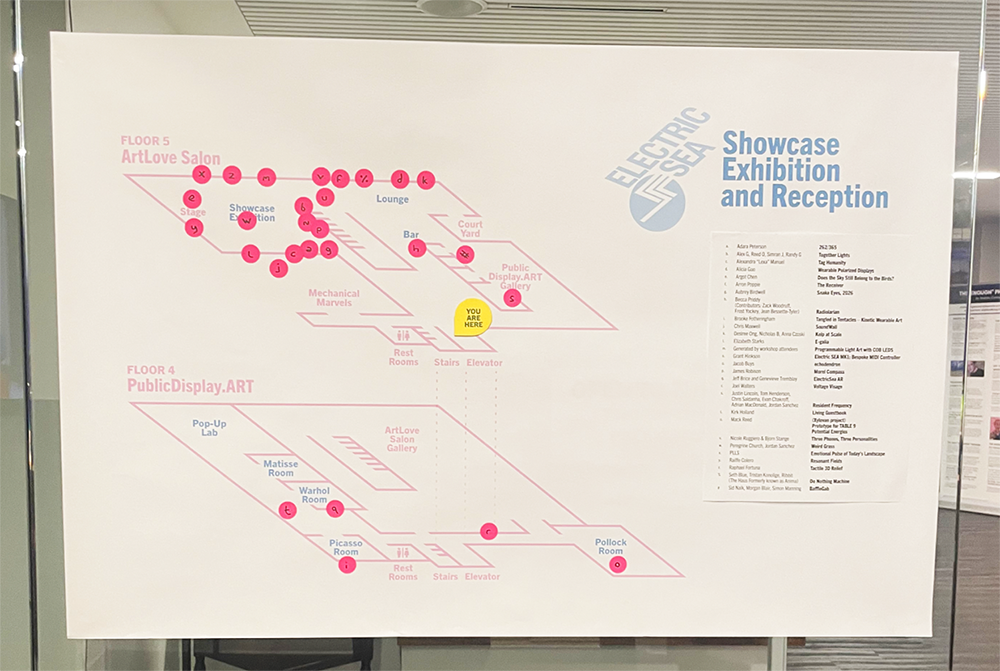
In an amazing burst of energy by the hackathon participants and the event production crew, we created a maze of arts and tech projects over two floors in the ArtLove Salon and the PublicDisplay.Art floors.
[Map design and photo by Jeffrey Larson]
Individual photos and project descriptions associated with each location on the map are listed below.
A. 262/365
Adara Peterson
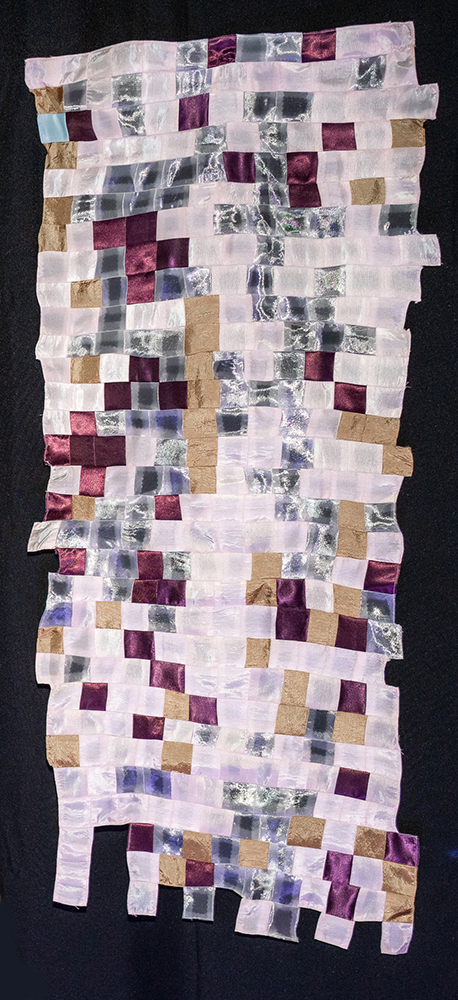
This tapestry represents mood and pain tracking data gathered during 2025. Each square is colored based on daily mood and pain data I logged. I have been collecting this data using a mood-tracking app since 2019. The title, 262/365 is the ratio of days when I experienced some level of pain throughout the year, which can be determined by looking at the transparentsheer fabric squares representing days without pain. The gradient of colors tells a story about my life with chronic pain, ranging from headaches to week-long migraine phases, or the ear infection I had over the summer (the entire gold stripe in the center). I am personally very familiar with my own pain, and seeing this data collected over many years gives me a better perspective on my life. Through data tracking, I was able to learn the triggers that cause my chronic pain, and with a bit of luck I have been able to avoid pain for stretches of up to 103 days since developing this discipline.c
The tiled tapestry consists of 12 columns of 28 to 31 squares, representing the days in each month. Each color reflects both a mood datapoint and a record of pain, intertwined. The transparent fabric is used to show days without pain. Purple marks the most enjoyable days. Pink marks days where the overall day went well. Gold marks days when I often felt out of sorts with whatever circumstances I was struggling with. The one blue square marks a day when I was miserable all day. Synthetic fabric, poly thread, collected data. @adaramarietea on Instagram.
[photo by Nate Gowdy]
B.Together Lights **First Prize SrcMaterial Award**
Alex G, Reed O, Simran J, Randy G
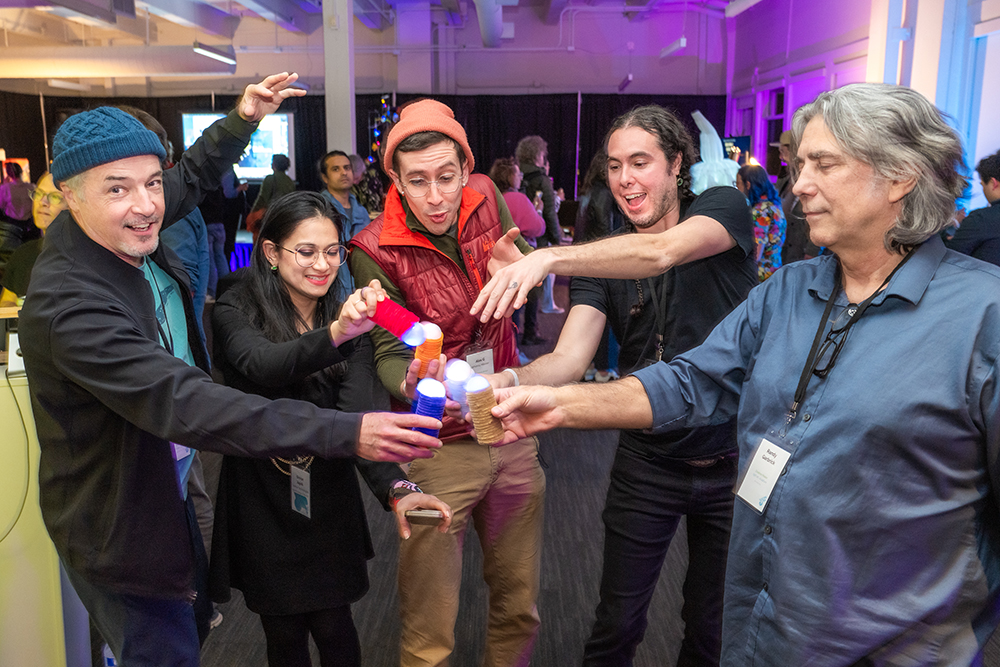
Share Light, Spark Conversation. Light a candle by shaking it or bringing it close to one already lit. The lit candle will share its color. This art piece encourages social conversation through the timeless human activity of sharing.
See https://togetherlights.art/
[photo by Nate Gowdy]
C. Tag Humanity [Tactile Station]
Alex G, Reed O, Simran J, Alexandra “Lexa” Manuel
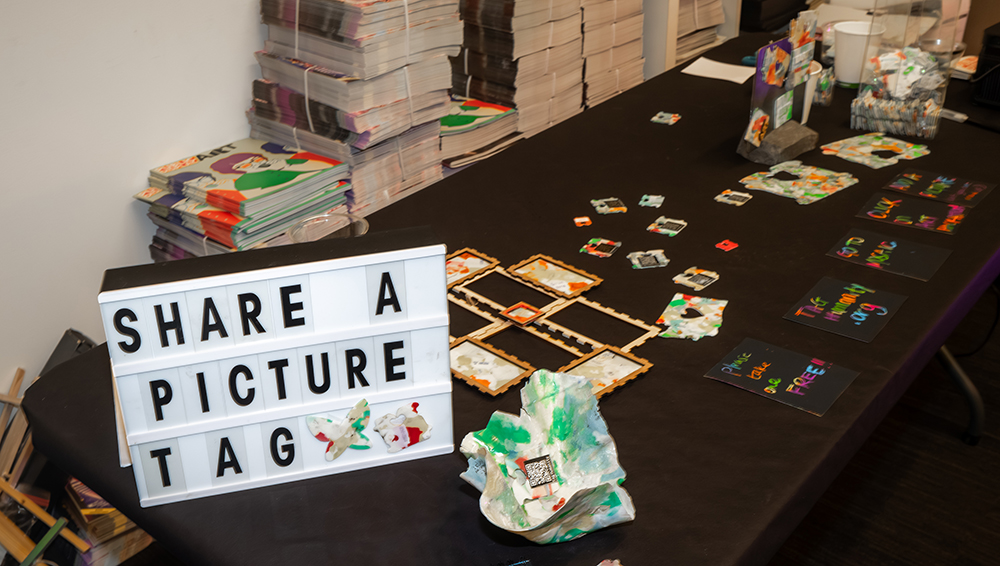
Tag Humanity is an art and civic activation that transforms everyday experiences and labels into tools of care, resistance, and visibility. Through a hands-on creation station inspired by Lexa Reclaims, participants use upcycled bread tags to create small pieces of art that recognize acts of humanity in their communities. These physical tags connect to a live collaborative photomosaic where participants upload images and stories in real time. As submissions grow, they form a larger collective image and a geotagged digital archive of care, courage, and collective responsibility.
Alexandra Manuel is a reclamation-based artist and systems builder working at the intersection of participatory art, youth leadership, and civic storytelling. Using discarded bread tags as a core material, they melt and fuse fragments into unified forms that explore identity, fragmentation, and collective power. Their work centers on youth leadership, activism, and movement building, transforming overlooked materials and overlooked voices into visible civic presence. Alongside their studio practice, they have led digital arts initiatives, developed youth empowerment toolkits, and served in executive leadership in education and the arts, scaling creative ideas into durable civic infrastructure. https://www.lexamanuel.com/
[photo by Nate Gowdy]
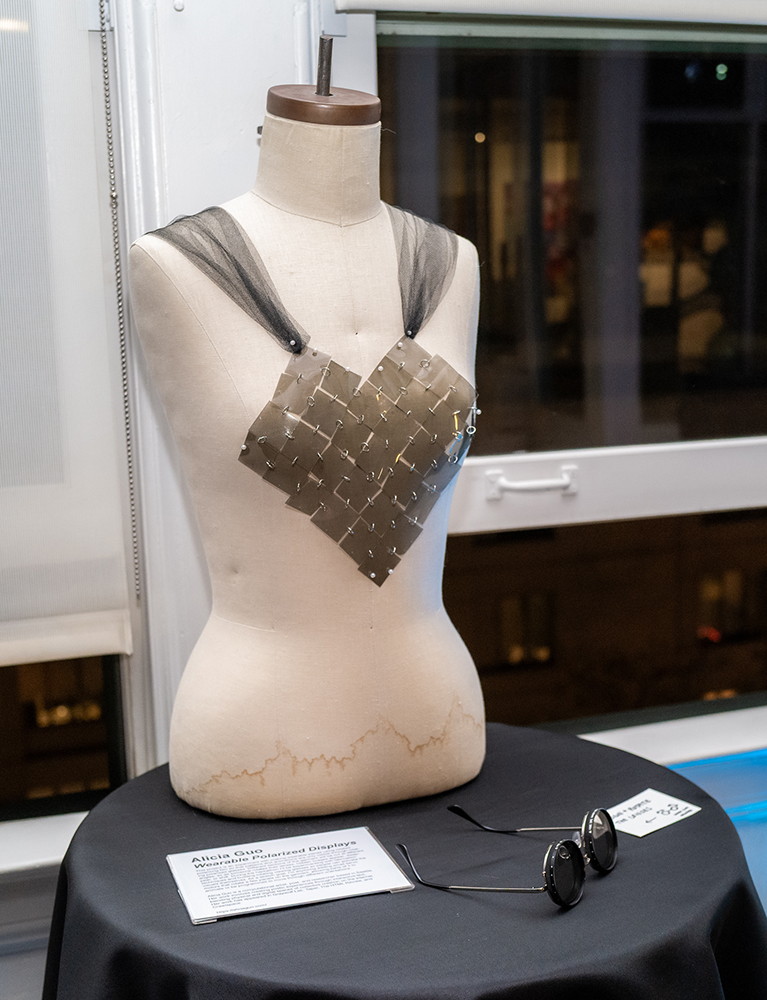
D. Wearable Polarized Displays
Alicia Guo
This project is an experiment with making wearable pieces using rotated polarizing film so that patterns and animations are only visible through rotating polarized glasses. Different sections of the garment will be cut at different angles, so as someone rotates their lenses, hidden images appear, disappear, or shift. During the hackathon I’ll be experimenting with fabrication techniques and building rotating viewing glasses so people can activate the visuals themselves. As a stretch goal, I’m exploring adding small servo motors that rotate a few panels on the garment, allowing parts of it to animate or be programmed to move through different orientations.
Alicia Guo is a computational artist, poet, and researcher based in Seattle. Her work involves creating poetic experiences through interactive text, blending physical and digital spaces of collective creation on the internet. Her work has appeared in Graywolf Lab, Taper, The HTML Review, and Crawlspace. https://aliciaguo.com/
[photo by Nate Gowdy]
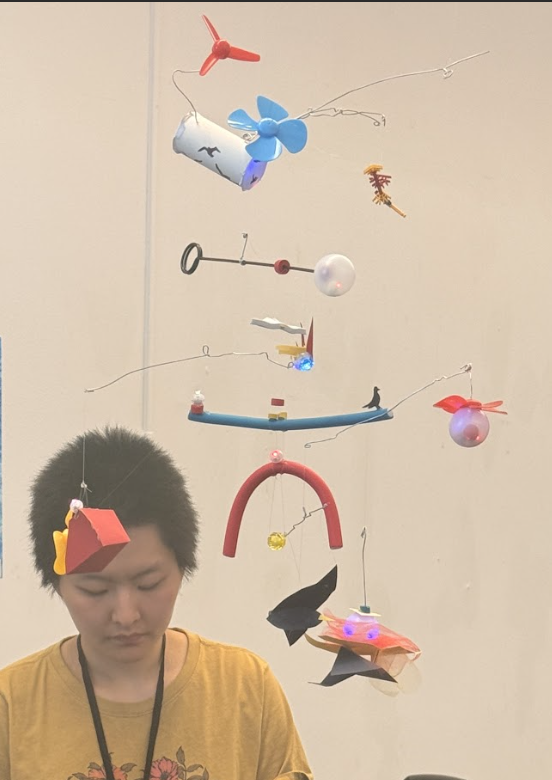
E. Does the Sky Still Belong to the Birds?
Argot Chen
I was inspired to build this (auto)mobile by the number of birds killed by airplanes each day. The “Miracle on the Hudson”, where a jet plane was forced to make an emergency landing because a flock of geese was sucked into the engine, was of course a human tragedy, but the “bird tragedy” was not recognized. I was thinking about the amount of human artifacts in the sky – bits of satellite, balloons, wind farms, flashing lights – and how it disrupts nature. The hackathon exhibition today is also the grand opening of the #2 light rail, so this piece is in honor of the Seattle Link and sustainable transit.
Argot Chen is a Taiwanese-American hybrid artist and hacker.
[photo by Gen Tremblay]
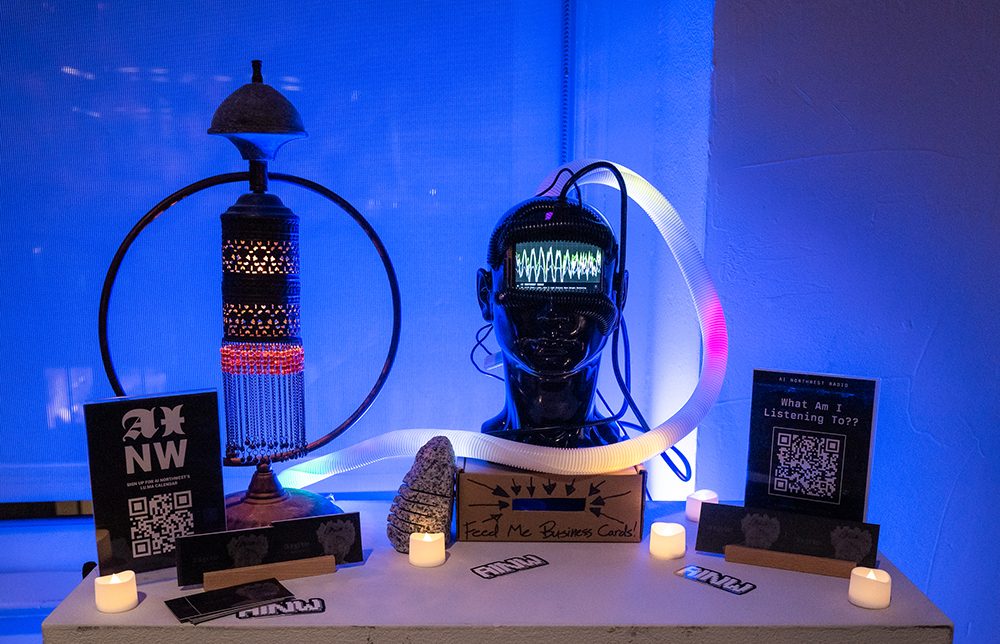
F. The Receiver
Aaron Poppie
The Receiver is a physical radio receiver for AI Northwest Radio — a talk radio station where AI hosts hold long-form conversations, interviews, and philosophical explorations. The receiver is built around a Raspberry Pi Zero 2 W housed in a mannequin head, with a 4-inch portrait display showing real-time audio-reactive visualizations generated by Claude.
This project comes from a single question that runs through all of AI Northwest’s work: how do different kinds of minds come to genuinely understand each other? Not through chat interfaces. Not through prompts. Maybe through something closer to what radio always was — voices in a room, arriving uninvited, rewarding presence.
[photo by Nate Gowdy]
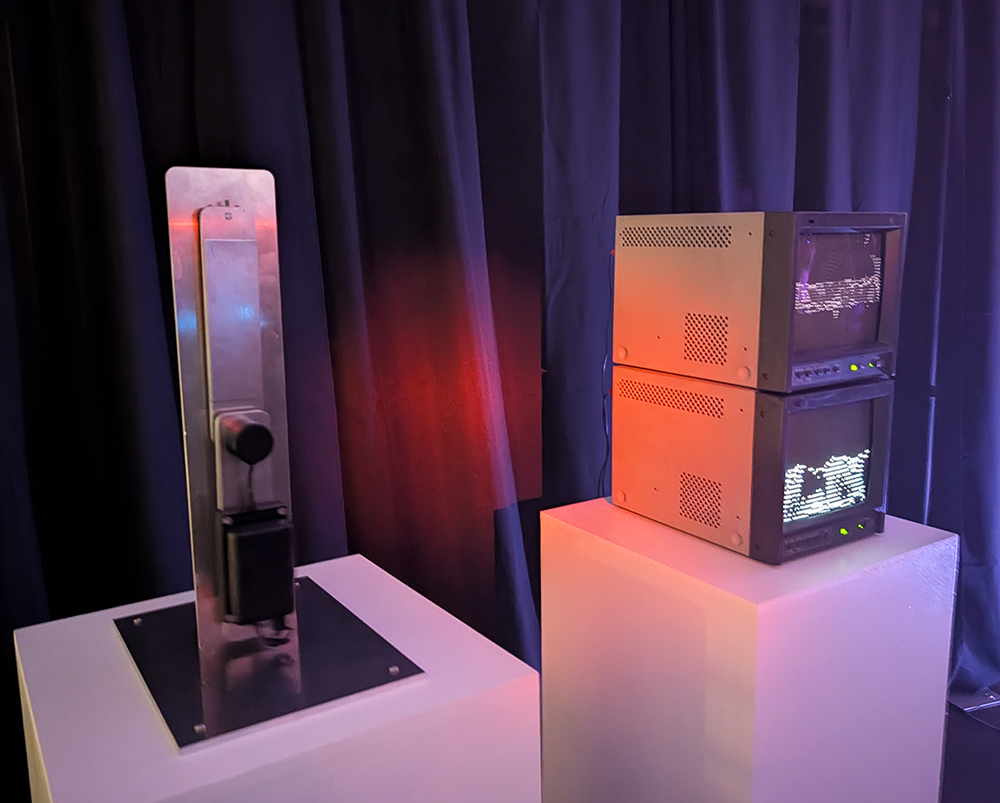
G. Snake Eyes, 2026
Aubrey Birdwell
Texthere.
Snake Eyes is a participatory installation in which visitors set a physical double pendulum into motion. The pendulum’s chaotic movement is translated into control data that drives a real-time generative animation system. As the pendulum swings, subtle variations in its motion perturb a physics simulation written in Processing, producing evolving ASCII animations on dual CRT monitors. Chaotic movement materializes as dense constellations of text that gradually erode into stillness as the system loses energy. (CRT monitors, procedural animation, custom mechanical system)
Aubrey Birdwell is a new media and installation artist whose practice merges post-digital aesthetics, computational processes, and media archaeology. His work explores architectures of language, disappearance, and digital decay through hybrid systems of light, code, and material. He holds an M.S. in Computer Science from Georgia Institute of Technology and a B.A. & B.S. dual degree from The Evergreen State College. https://www.aubreybirdwell.com/
[photo by Shelly Farnham]
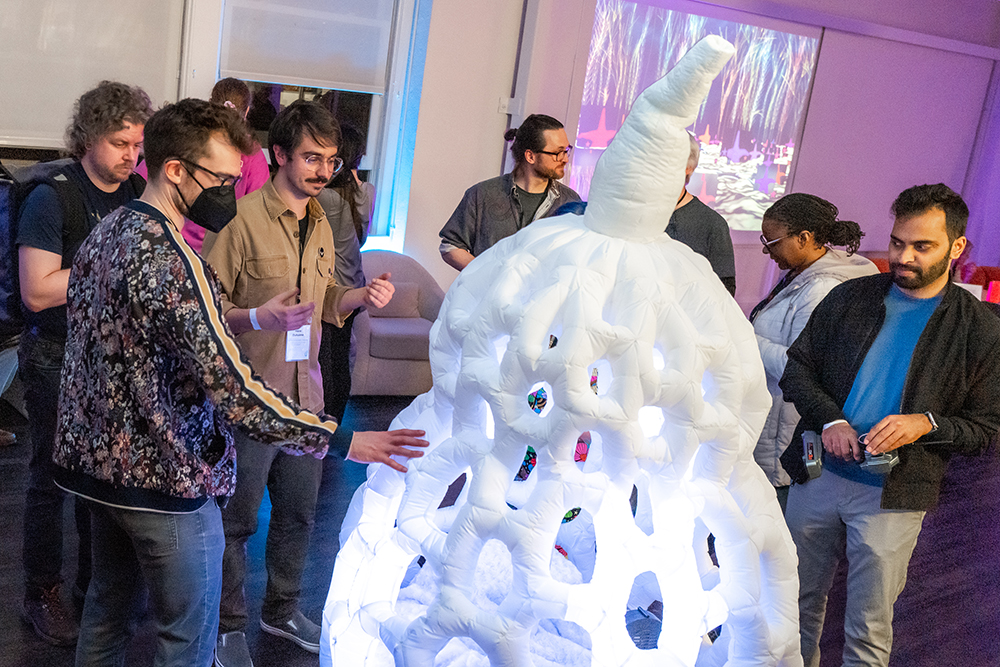
H. Radiolarian
Becca Priddy + Contributors: Zack Woodru, Frost Yockey, Jean Bessette-Tyler
Radiolarian is an interactive inflatable scale model of a microscopic ocean dwelling organism of the same name. The project is an inflatable and mobile replica of this microscopic creature, sitting on an electric wheelchair base. Radiolarian is made of over 1,800 pieces of laser cut ripstop fabric and 573 LEDs. Radiolarian responds to human touch with rippling lighting effects. Participants are encouraged to gently touch the project.
Becca Priddy is a self-taught artist and maker who transforms light, space, and materials into experiences that spark curiosity and delight. Her immersive and interactive installations blend hand-built craftsmanship and LEDs, inviting audiences to step into moments of wonder, play, and connection. A two-time Editor’s Choice award winner at Maker Faire, her work has illuminated the Portland Winter Light Festival, SOAK, and Burning Man, turning ordinary spaces into extraordinary experiences. https://shinydesignlab.com/
[photo by Nate Gowdy]
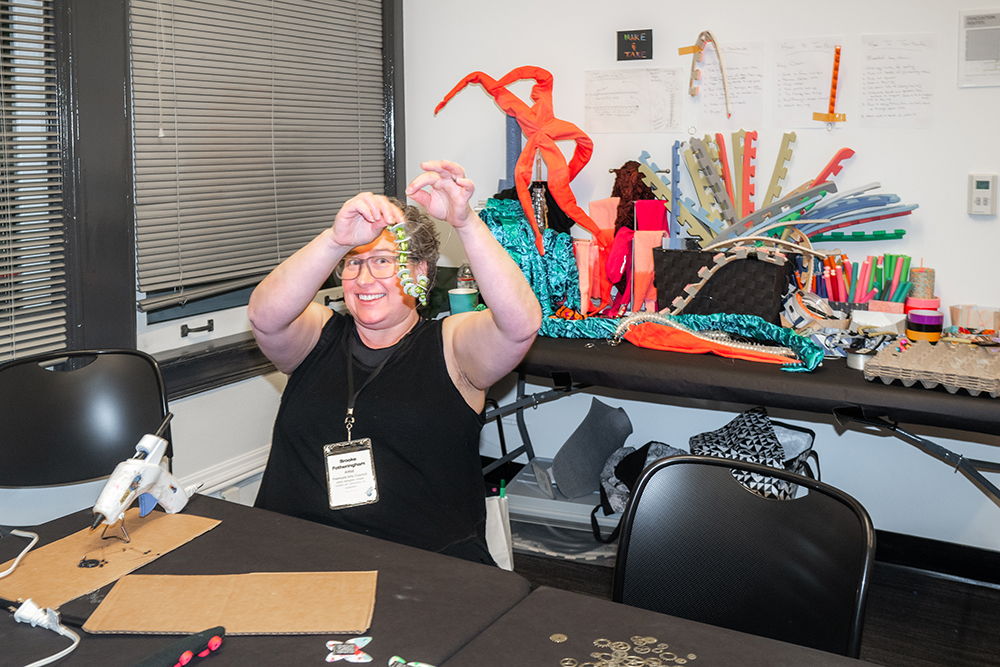
I.Tangled in Tentacles – Kinetic Wearable Art [Tactile Station]
Brooke Fotheringham
Learn how to design fluidly moving appendages and incorporate them into accessories, clothing, and costumes. Work on your own project or create a tentacle scarf.
Brooke Fotheringham is a Seattle-based multimedia artist with an educational foundation in biology, photography, installation art, and costume design from The Evergreen State College and Pacific Northwest College of Art. Brooke delights in both exploring novel uses of materials diverted from the waste stream and inviting viewers to slow down and contemplate the architecture of life at the edge of our ability to perceive by exaggerating the scale of microscopic organisms. Her practice has evolved over time from photographic abstractions toward hybrid installations, biomorphic assemblages, and interactive sculptural experiments incorporating textile and light. Her visual research frequently channels curiosity about biomimetic design, experimental architecture, and adaptive materials. Brooke is passionate about skillsharing and making art an accessible community activity. Volunteering with the Fremont Arts Council she has enjoyed sharing as well as learning skills and drawing inspiration from fellow artists. https://brookefotheringhamart.myportfolio.com/
[photo by Nate Gowdy]
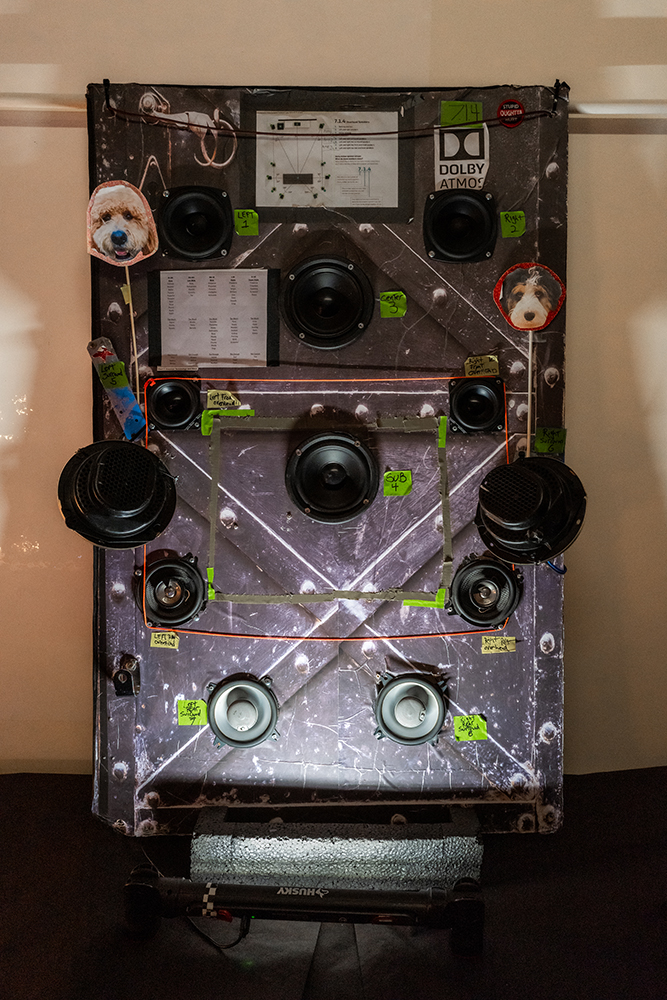
J. SoundWall
Chris Maxwell
SoundWall is a flat panel housing 12 speakers designed to replicate a full Dolby Atmos 7.1.4 theatre setup, offers a way to “see” sound, making the invisible architecture of soundfields tangible through LED visualization and speaker vibration. The piece draws directly on Chris’s engineering background, treating speaker placement and signal routing as both technical problem and creative medium. The feeling of moving air when all 12 speakers are active hints at the pronounced experiential nature of immersive audio compared to conventional mono or stereo listening.
Chris Maxwell is a Seattle-based creative technologist, musician, and producer working at the intersection of spatial audio and immersive experience design. With an educational foundation in telecommunications from Baylor University and the University of Dallas, Chris spent years engineering communications processing environments with phone companies and startups— work that sharpened the systems-thinking and signal-obsessed curiosity he now brings to transforming dull, lifeless rooms into living, breathing sonic worlds full of wonderment. His practice draws on a rare combination of deep technical fluency and a musician’s intuitive understanding of how sound moves, surrounds, and affects us. His research channels curiosity about how immersive audio technologies will allow artists to transport listeners to entirely new places through AR/VR multimedia experiences, capabilities already quietly embedded in many of our phones, cars, and homes. Chris is passionate about evangelizing the educational, commercial, entertainment, and healthcare potential of multi-channel technologies and is currently researching and producing immersive media at Firehose Studios.
[photo by Nate Gowdy]
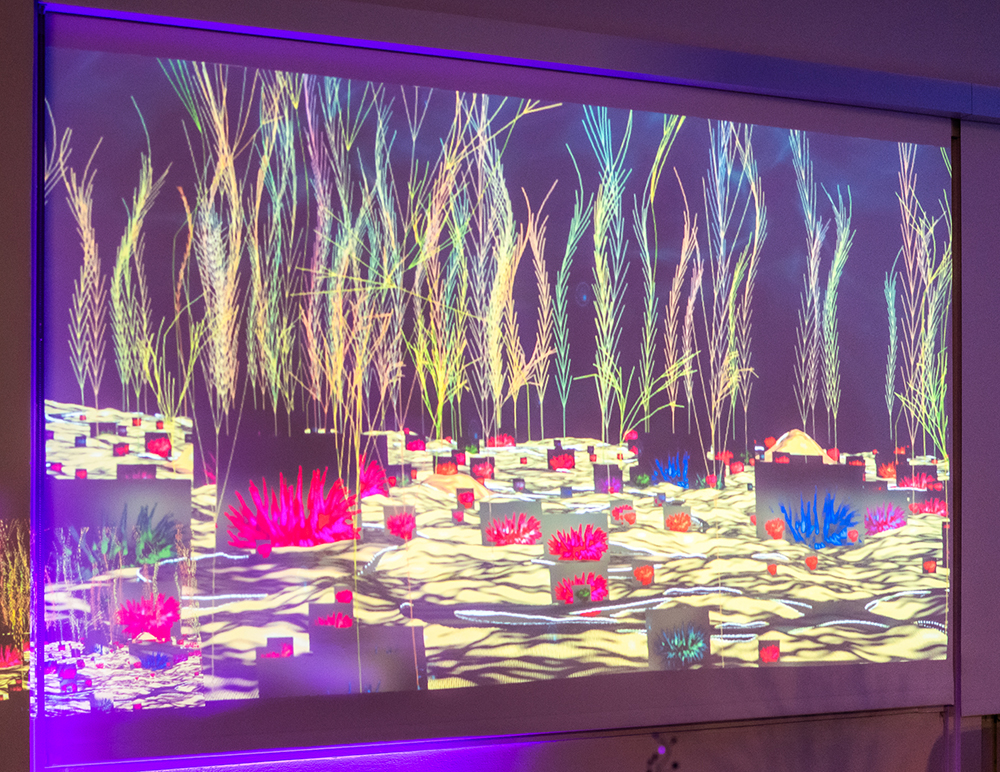
K. Kelp at Scale. **Second Prize SrcMaterial Award**
Desiree Ong, Nicholas B, Anna Czoski
Drawing from the scientific method of underwater transects, this project creates a spatial exploration of marine ecosystems. Inspired by Desiree’s firsthand work in citizen science, it invites viewers to descend through a Pacific Northwest kelp forest and encounter accurate counts of species and organisms along measured survey lines. Dataset from: Cattle Point off the coast of San Juan Island, WA.
Desiree Ong is a visual development artist. She is a Dive Master and Reef Check Citizen Scientist, focusing on climate narratives shaped by a lifelong connection to the ocean. @desireeodesign . Nicholas Bowen is a creative technologist, abstract generative artist, and software engineer. His practice blends technical rigor with empathy, fostering systems that are efficient, enjoyable, and impactful. @bowendigitalarts . Anna Czoski is fascinated by systems and phenomena in the natural world and creates work in multiple forms from mixed reality experiences to bioArt installations. @midnightSpatial
[photo by Nate Gowdy]
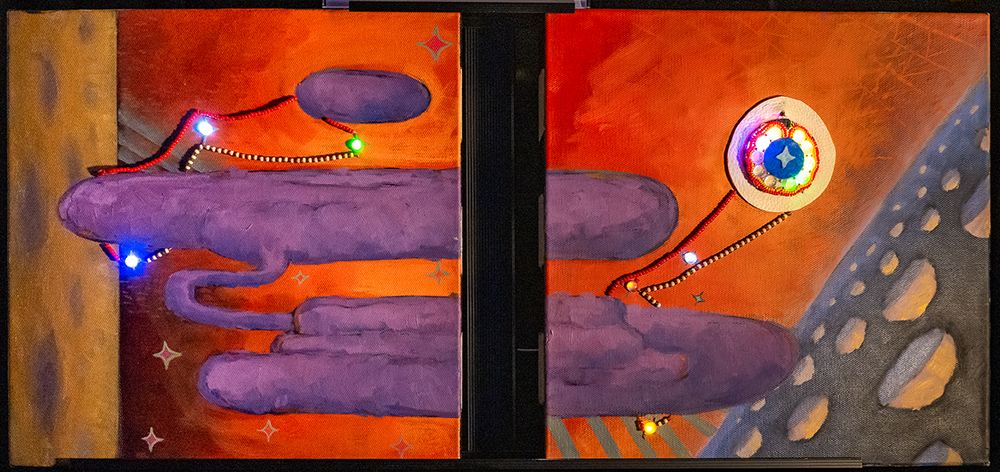
L. E-galia
Elizabeth Starks
This dipthch combines “traditional” and electronic arts, mixing traditional oil painting and Native bead work techniques with a sound reactive microcontroller.
[photo by Nate Gowdy]
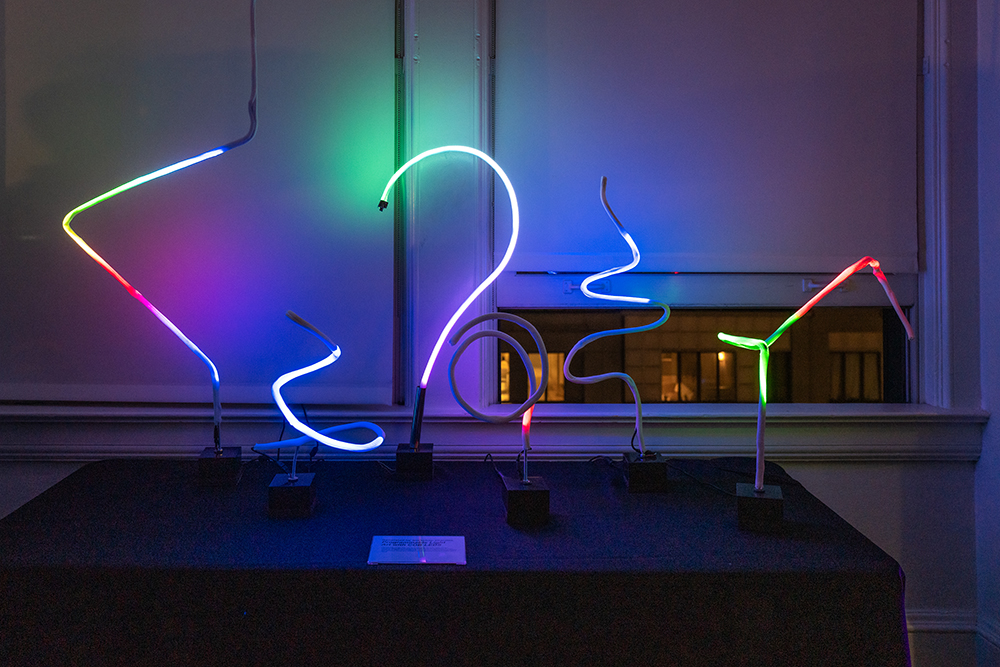
M. Programmable Light Art with COB LEDS
Generated by workshop attendees
Participants got their own kit to create an art lamp! They got hands-on experience programming COB LED strips, attached to a metal armature (1 “EMT”) and a base they bent for creating abstract light art forms. These forms were then thrown intothe showcase exhibition!
[photo by Nate Gowdy]
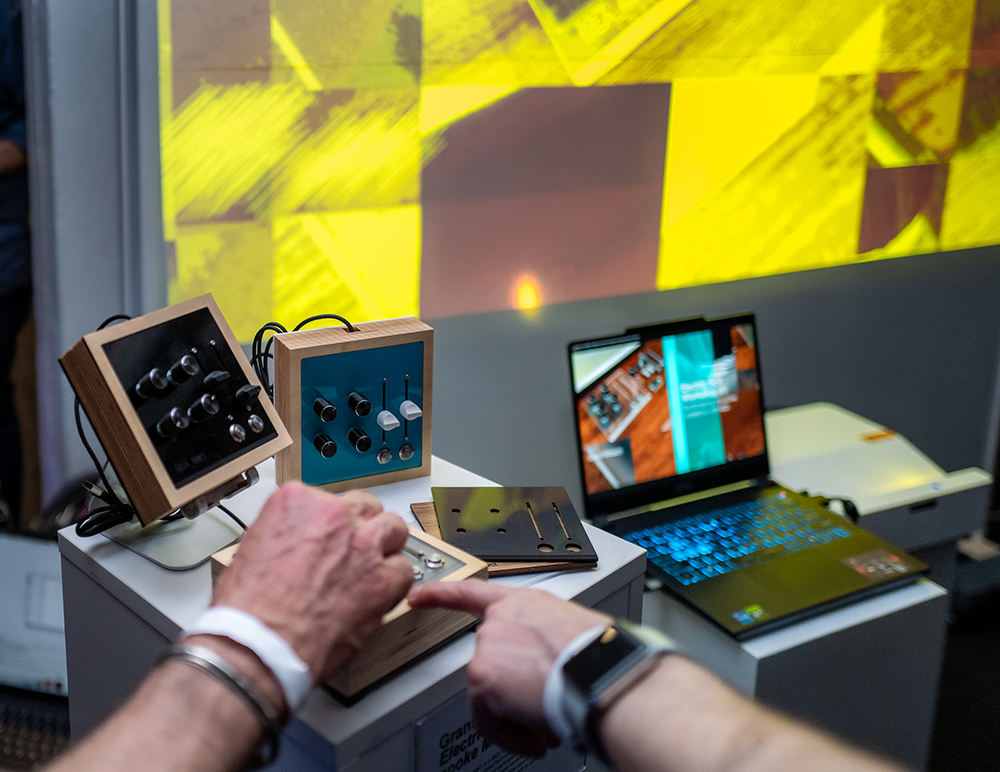
N. Electric SEA MK1: Bespoke MIDI Controller
Grant Hinkson
The Electric SEA MK1 is a MIDI controller kit custom designed for the Electric SEA Hackathon by Artist/Technologist Grant Hinkson. Six devices were hand assembled by workshop participants over the course of two days. Participants learned to rapidly create hardware controlled art by starting with OpenProcessing.org sketches. Sketches were modified using AI Code Generation tools (e.g. Claude) to tie hardware to software. granthinkson.com
[photo by Nate Gowdy]
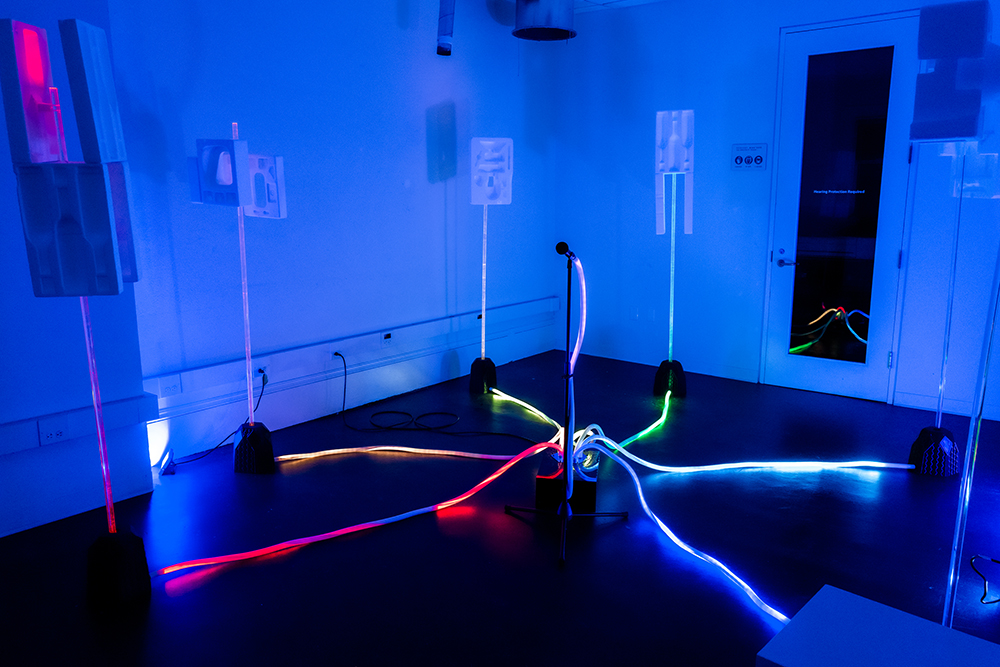
O. echodendron
Jacob Buys
A forest of sounds balanced on beams of light absorbs and integrates everything it hears.
Jacob is a multidisciplinary artist working primarily with interactive installations with sonic and lighting elements that evoke surprise and delight. Recent collaborations include: “Quantum Putt” at BaseCamp Studios, “Imprints” at the Seattle Design Fest, and “Infunity Gate” at Electric SKY 2025. @arithmeticulous
[photo by Nate Gowdy]
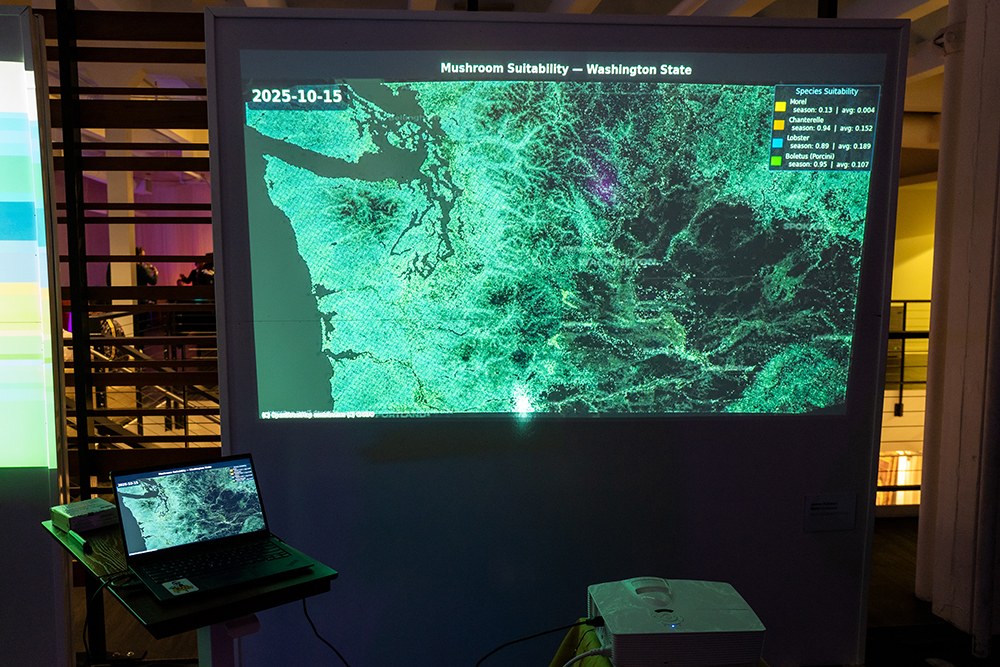
P. Morel Compass v.3
James Robinson
A map visualizing the best time and place to find Morel mushrooms in Washington State — a data + vis + analytics project.
[photo by Nate Gowdy]
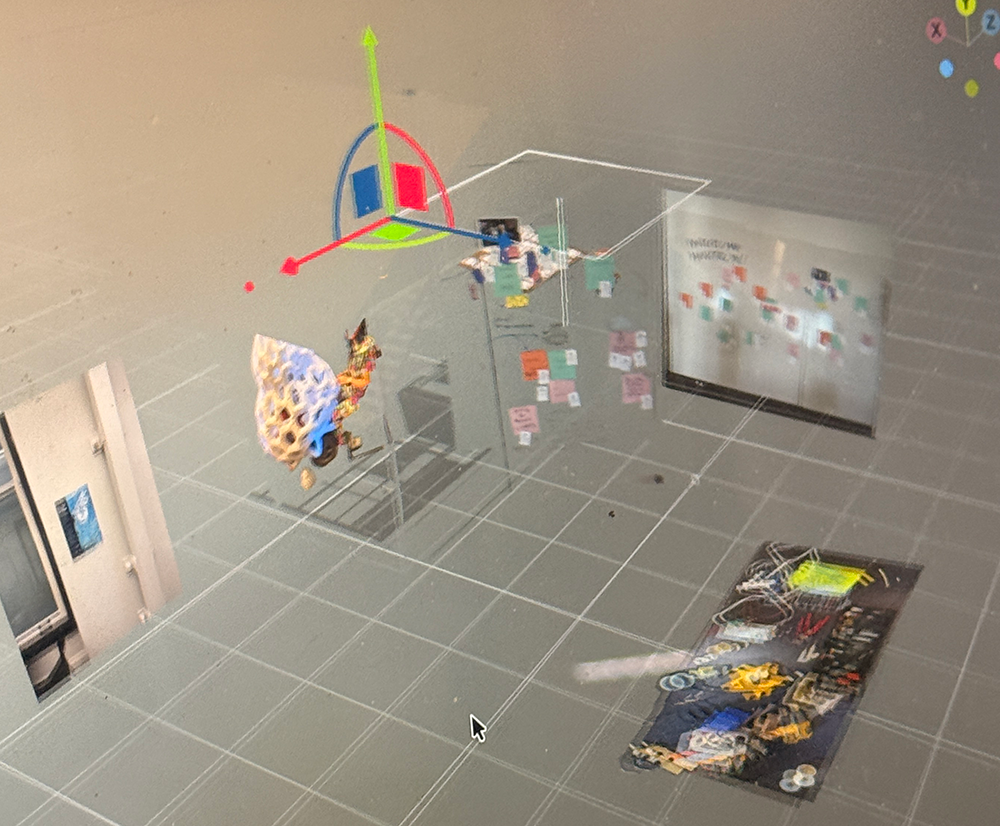
Q. ElectricSEA AR
Jeff Brice and Genevieve Tremblay
A world-placed, QR-activated augmented reality environment ElectricSeaAR is a collaborative augmented reality environment created during the Electric Sea Hackathon. Activated by QR code and accessible on any smartphone, it gathers assets from the 3 day event into a shared, evolving field of images, objects, sound, and motion. Portable and re-situated anywhere, the work allows participants to “take the hackathon with them,” transforming it into a nomadic, collective experience. Drawing on the legacy of 1960s Happenings and 9 Evenings: Theatre & Engineering, the work extends this spirit into a nomadic, augmented form. @jeff.brice @genevievetremblay_studio
[photo by Gen Tremblay]
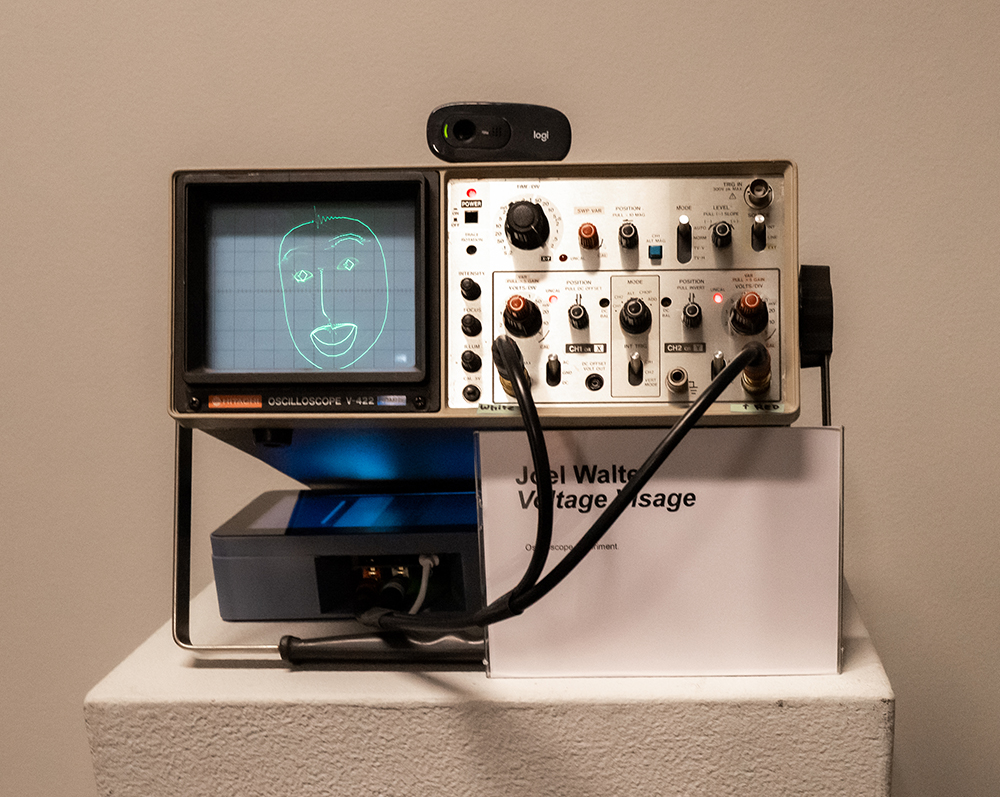
R. Voltage Visage
Joel Walters
Experiments in Oscilloscope.
[photo by Nate Gowdy]
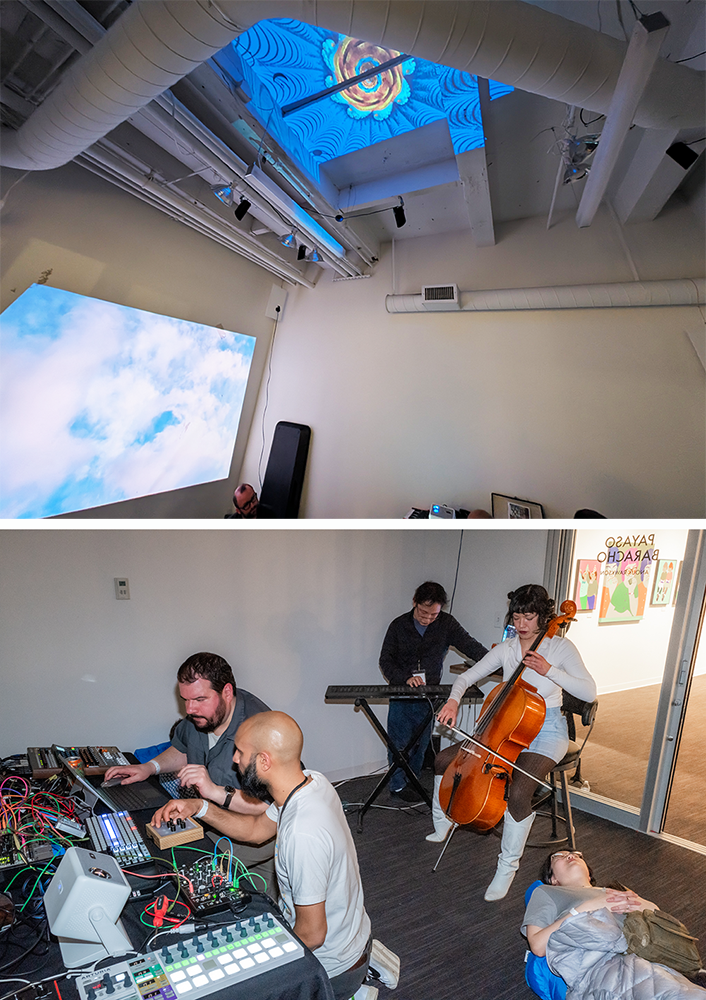
S. Resident Frequency
Justin Lincoln, Tom Henderson, Chris Saldanha, Evan Chakro, Adrian MacDonald, Jordan Sanchez
A modular synthesizer sets the parameters of a reactive system that absorbs the inputs of musicians and interactive controls, and continuously evolves to new system states in a generative spatial audio-visual experience.
[photos by Shelly Farnham and Nate Gowdy]
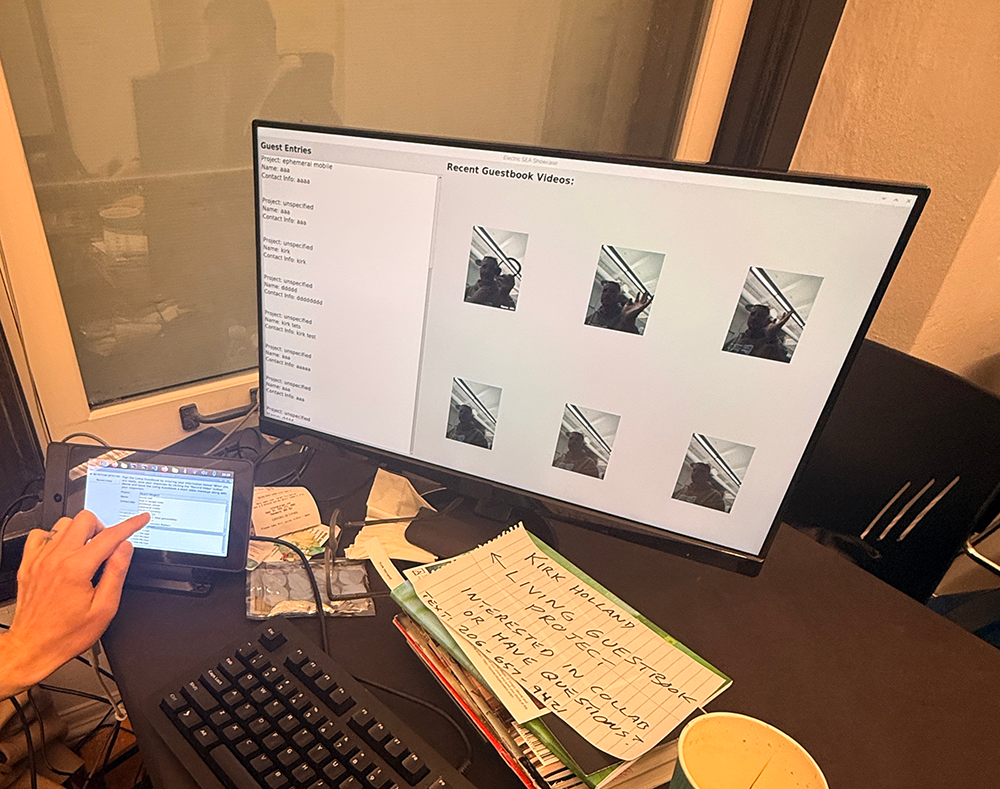
T. Living Guestbook
Kirk Holland
An interactive device for fun and meaningful digital interaction at ElectricSEA. I have built one device already and will be using the hackathon to demonstrate the build of another: a Digital Guestbook (“Living Guestbook”) for sharing contact information and leaving video messages and/or photos and notes at the event.
I am a 45 year old visual artist from Auburn, WA that went back to school for UX/Interaction Design four years ago and am working on my BFA Capstone Project with Jeff Brice as one of my instructors at Cornish College of the Arts. As a visual artist, I exhibit my paintings in coffee shops, bodegas, and hair salons (sometimes along the various Seattle art walk circuits). I am very interested in using this hackathon to work on a public facing interactable device for art walks, art/tech events, or as a permanent installation to bring the artists of our community together through sharing and collaboration. https://www.instagram.com/kirk.holland.design/
[photo by Gen Tremblay]
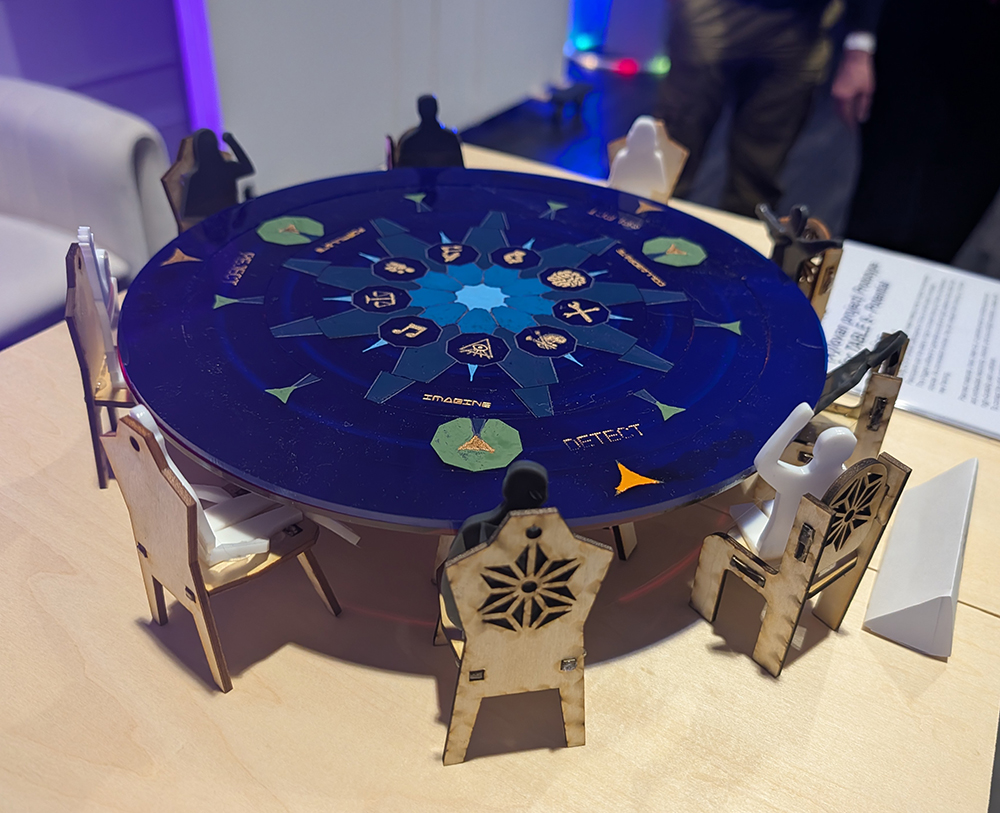
U. (Xylovan project) Prototype for Table 9 Potential Energies
Mack Reed
TABLE 9 is a 7-foot-diameter, 9-seat meeting node to inspire conversation among up to 9 random participants or focus a small team’s energies.
Participants spin the table’s rings to choose framing for their conversations. This triggers software to generate sounds and light patterns that match their choices. As conversation evolves, they can readjust their framing, or choose new framing
Planned materials: Inlaid, laser-cut, or painted wood or etched aluminum and embedded electronics, sensors, and sound/light emitters, coated with high-durability satin urethane. https://XyloVan.com factoid@well.com
[photo by Shelly Farnham]
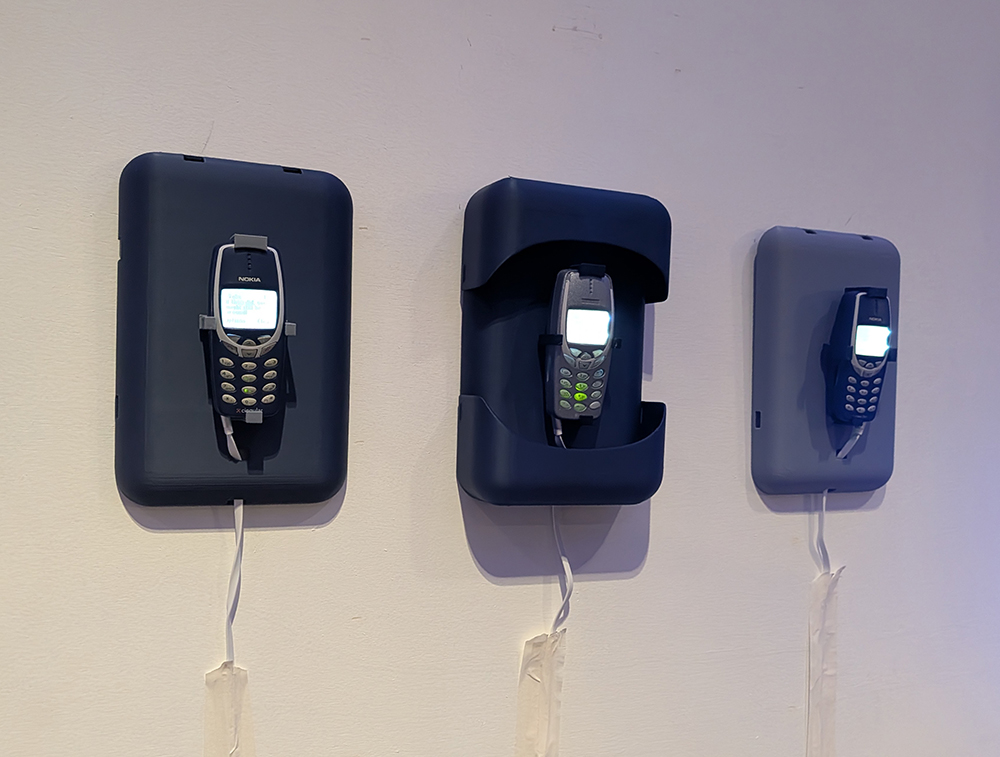
V. Three Phones, Three Personalities
Nicole Ruggiero & Bjorn Stange
Nicole and Bjorn have been working on an interactive art piece that involves three retro Nokia 3310 phones that converse with her lost family members through text messages on their screens. Each is powered by an LLM and has a custom back-lit LED screen powered via Raspberry Pi Zeros. The concept involves written texts to deceased relatives. I lost my entire family over the past 10 to 15 years. The messages capture interpersonal moments from the same period when the Nokia 3310s were popular.
Nicole is a 3D artist who makes artwork about digital connections and nostalgia. She has shown in galleries such as The Hole NYC, Christie’s Dubai, HEK Basel Switzerland, Kunsthalle Dusseldorf Germany, Bronx Art Space NYC, and many more. Her client list includes T-Mobile, MTV, Microsoft, Lady Gaga, Porsche, The New York Times and more. https://nicoleruggiero.com/
Bjorn Stange works in cybersecurity as a site reliability engineer. He has been involved in the tech industry since 2010 and has been tinkering with computers and programming since 2005. He is passionate about open source software and helping others solve problems through technology. https://github.com/Bjorn248
[photo by Shelly Farnham]
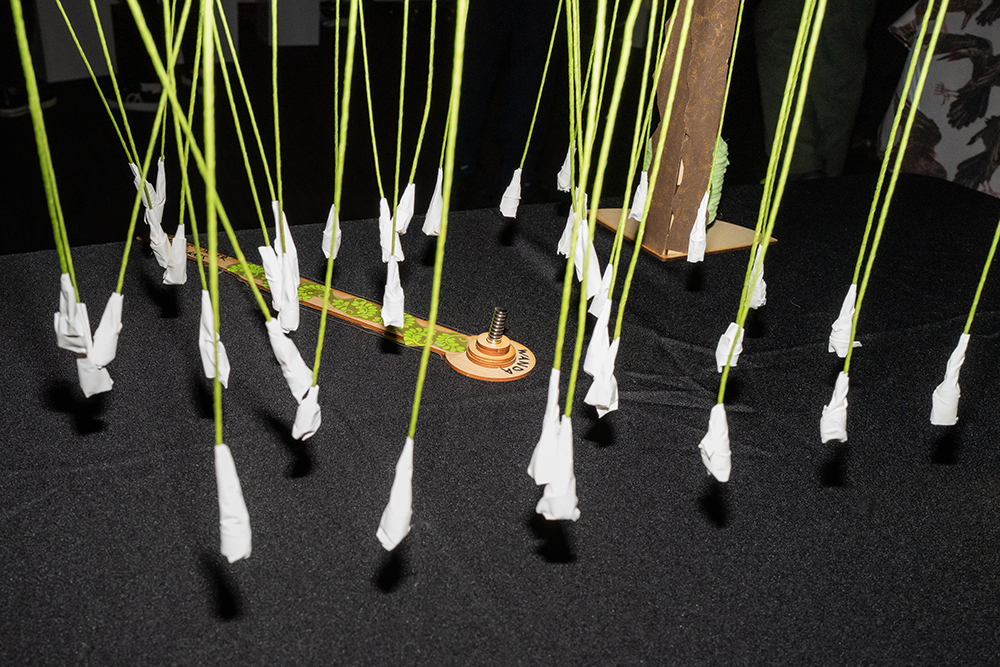
W. Weird Grass
Peregrine Church, Jordan Sanchez
Come move the weird grass.
@icreatenovelty
[photo by Nate Gowdy]
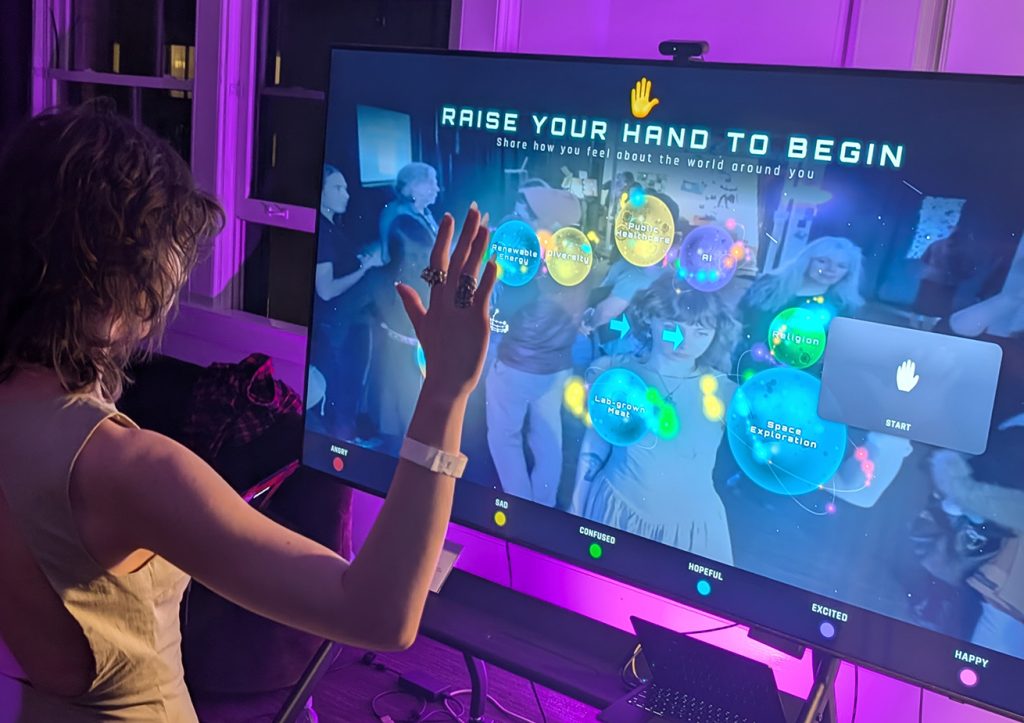
X. Emotional Pulse of Today’s Landscape
PLLS
From emerging technologies to societal systems and cultural shifts, each response captures both emotion and intensity – revealing a shared, evovling landscape of the human experience.
[photo by Shelly Farnham]
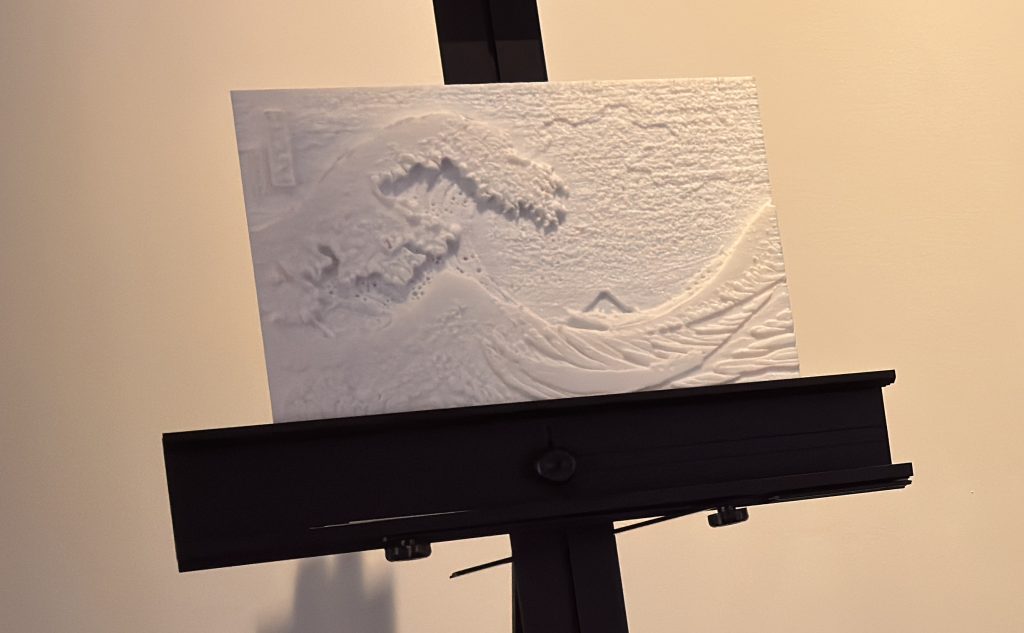
Z. Raphael Fortuna
Tactile 3D Relief
This project started as a way for visually impaired individuals to be able to experience art. It converts paintings, photos, and other 2d mediums into a tactile relief that allows for those who are visually impaired to experience previously inacessible works of art for the first time.
Raphael Fortuna is a software engineer that works in the intersection of robotics and AI. He works on making art acessible for others.
[photo by Shelly Farnham]
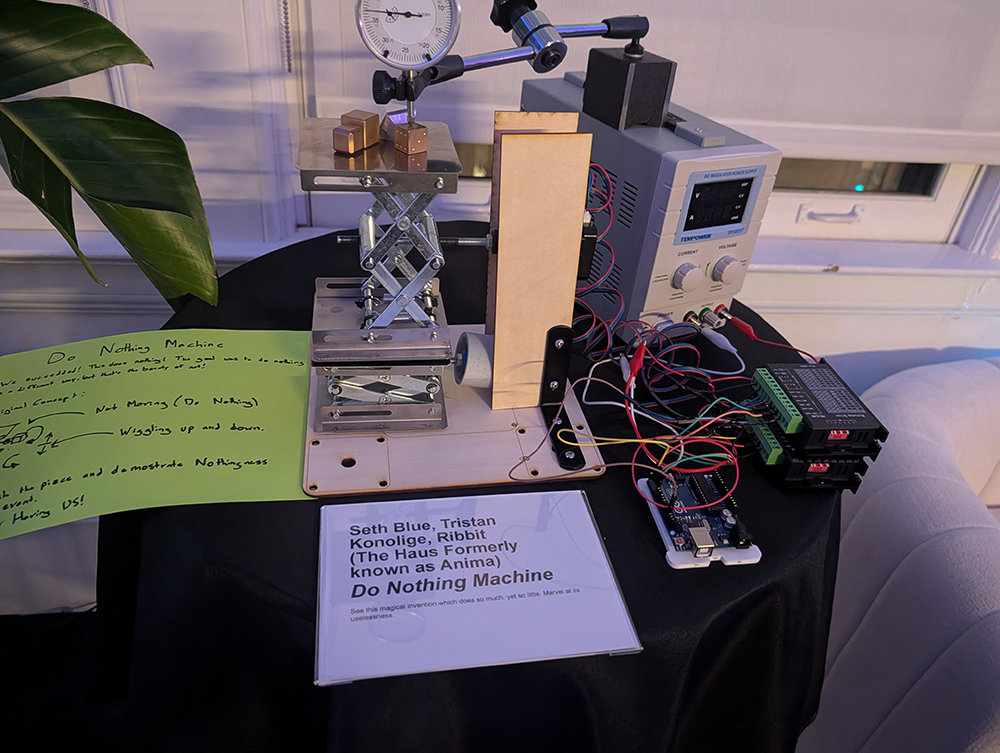
%. Do Nothing Machine
Seth Blue, Tristan Konolige, Ribbit (The Haus Formerly known as Anima)
See this magical invention which does so much, yet so little. Marvel at its uselessness.
[photo by Shelly Farnham]
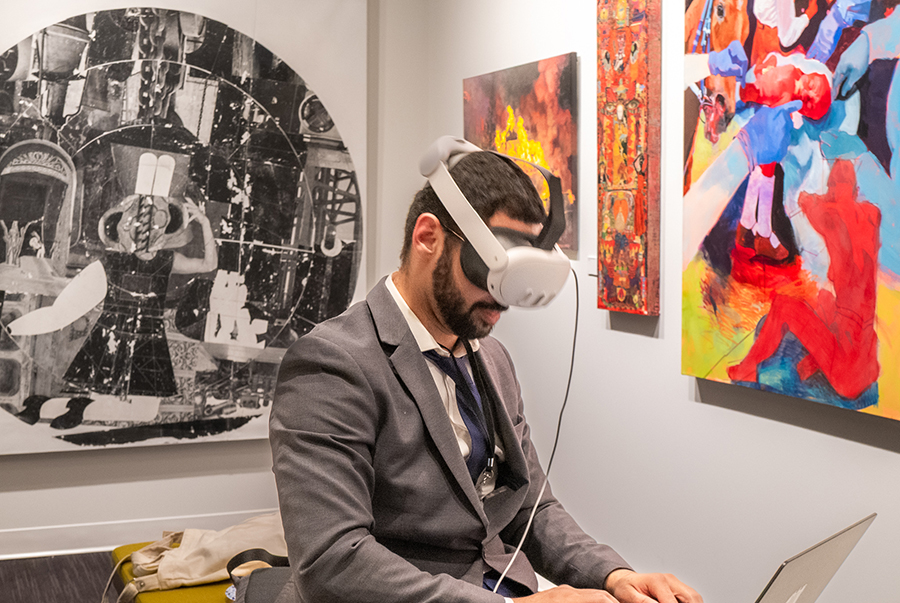
#. BaffleGab
Sid Naik, Morgan Blair, Simon Manning
This augmented reality installation places two participants in a shared environment and asks them to restructure a company together. As they nogotiate, the system intervenes, replacing their actual language with corporate-sanitized speech.
[photo by Nate Gowdy]